


Nuclear Medicine (Soon: in english)
- Presentation
- Healthcare services
- Team
- Research
- Teaching
- Contact
Codi servei: MNUSVGT
Recerca:
Research and innovation are fundamental pillars for building knowledge. The department’s approach is always multidisciplinary and cross-disciplinary.
The department has a long-standing research tradition which, together with the upgrading of the new Radiopharmacy Unit, the commencement of PET/CT activities and the opening of the metabolic therapy room, has made it possible to significantly increase the number of research projects in which it participates, both in clinical practice and in collaboration with the pharmaceutical industry.
The department is currently participating in several clinical trials investigating the therapeutic use of new radiopharmaceuticals in Phase I, II and III.
Several clinical research studies in routine clinical practice are also under way to assess treatment response in both oncological and non-oncological conditions.
Furthermore, the department is working to incorporate technological innovation and digital transformation through various ongoing projects.
Presentation:
The Nuclear Medicine Department is part of the Clinical Directorate of Diagnostic Imaging.
It supports the Hospital’s clinical departments and those across the Northern Metropolitan Area in functional imaging diagnostic tests using radiopharmaceuticals (SPECT/CT and PET/CT), in nuclear medicine-assisted surgical techniques (sentinel lymph node biopsy and radioguided surgery for occult lesions), and in metabolic therapy and selective internal radiotherapy device treatments.
The complete refurbishment of the department’s infrastructure has provided it with state-of-the-art digital SPECT/CT and PET/CT equipment, an outpatient metabolic therapy room and a Radiopharmacy Unit that meets all current legal requirements for the preparation and dispensing of conventional and PET radiopharmaceuticals, which are essential for the department’s daily activities.
The high level of professional expertise of the team, comprising Nuclear Medicine specialists, Radiopharmacy specialists, nursing staff, diagnostic imaging technicians and administrative staff, enables the department to make the best use of its resources to provide comprehensive, high-quality care, both medically and from a human perspective, while maintaining its commitment to excellence and innovation.
The department’s objectives are:
- To work towards improving care for the population within its catchment area in all matters relating to nuclear medicine.
- To participate in multidisciplinary teams in order to integrate the cross-disciplinary expertise of the speciality into different clinical settings.
- To advance towards personalised medicine within the context of theranostics.
- To generate clinical evidence on the new digital SPECT/CT and PET/CT equipment that has been introduced.
- To lead the way in implementing new radiopharmacy-PET processes, such as the use of the ⁶⁸Ge/⁶⁸Ga generator.
Highlights from the Germans Trias Nuclear Medicine Department
Tipus Servei: 5
Correu: nuclear.germanstrias@gencat.cat
Docència:
Undergraduate Teaching
The department has an associate professor (Virgínia Vallejos) at the UAB Teaching Unit at Germans Trias, who contributes to the Clinical Radiology (core) module, covering the Nuclear Medicine component. Other medical specialists also contribute to undergraduate clinical seminars.
Postgraduate Teaching
The department is accredited to provide postgraduate training for two Nuclear Medicine residents per year and one Radiopharmacy resident per year.
It also welcomes residents in Radiology, Cardiology and Oncology.
Information for Residents
Please consult:
The department is divided into several sections:
- Conventional Nuclear Medicine
- PET/CT
- Radioguided Surgery
- Metabolic Therapy
- Beta-emitting Device Therapy
- Radiopharmacy
Residents undertake internal rotations across all sections and through different departments within the hospital. The department also encourages and supports overseas placements at centres of excellence, allowing residents to broaden and complement their training.
Residents are also encouraged to participate in doctoral research projects throughout their residency.
Continuing Training
Residents actively participate in journal clubs, specialist topic sessions and clinical case presentations, as well as in all the multidisciplinary committees in which the department is involved.
Residents are also encouraged and supported in attending the national and international courses and conferences considered most relevant to their training.
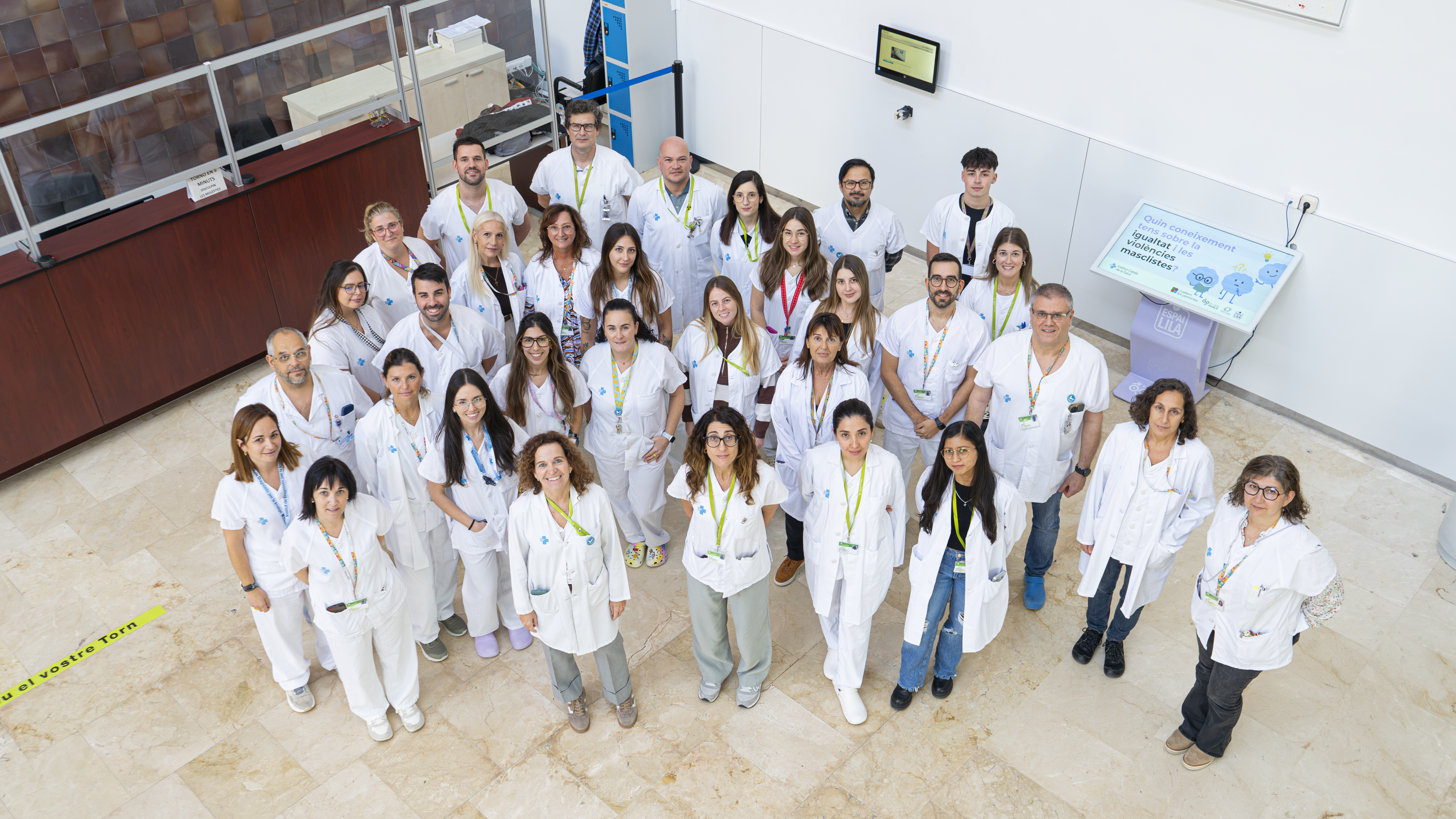
Medical Team
Glòria Moragas Freixa
Head of Department
Ana Paula Caresia Aróztegui
Clinical Lead, PET/CT
Virgínia Vallejos Arroyo
Theranostics Lead. Resident Tutor
Maria Boronat de Ferater
Specialist in Nuclear Medicine (IDI)
Jordi Deportós Moreno
Specialist in Nuclear Medicine (IDI)
Sergio Lafuente Carrasco
Specialist in Nuclear Medicine
Mª Teresa Salcedo Pujantell
Specialist in Nuclear Medicine
Montserrat Solà Suárez
Specialist in Nuclear Medicine (IDI)
Angelica Chanchumanya Huatuco
Specialist in Nuclear Medicine (IDI)
Laura Blanco Verdejo
Specialist in Nuclear Medicine
Jorge Luís Díaz Moreno
Specialist in Nuclear Medicine
Percy Hinojosa Salas
Specialist in Nuclear Medicine (IDI)
Rocío Ferrándiz Hervella
Nuclear Medicine Resident
Xiomara Valverde Guillen
Nuclear Medicine Resident
Heizel Hugel Carrasco
Nuclear Medicine Resident
Radiopharmacy Unit
Joaquim Riba Jofré
Clinical Lead, Radiopharmacy
Sergio Ruiz Llama
Specialist Radiopharmacist. Resident Tutor
Clara Garcia Alcober
Specialist Radiopharmacist
Judit Mora Sospedra
Radiopharmacy Resident
Nursing Team and Higher-Level Technicians in Diagnostic Imaging and Nuclear Medicine (TSDIMN)
Martí Boix Coll
Supervisor
Darío Manteca López
IDI Supervisor
José Antonio Cordero Ramajo
Nursing Team (IDI)
Mónica Díaz López
Nursing Team
Gregorio Jimenez Lozano
Nursing Team (IDI)
Meritxell López Gómez
Nursing Team
Noemí Torres Nuncio
Nursing Team
Rocío Linares Morcillo
Nursing Team
Rebeca Benito Paredes
TSDIMN Team
Noelia Cardós Ninguillán
TSDIMN Team
Mónica Caro Solís
TSDIMN Team
Natalia Ibañez García
TSDIMN Team
Cristina Leal Perez
TSDIMN Team
Joseph Molina Parra
TSDIMN Team
Alba Olmo Crespo
TSDIMN Team
Javier Palacios Pastor
TSDIMN Team
Cristina Pons Saenz
TSDIMN Team
Jorge Salamero García
TSDIMN Team
Laura Zamora Cantero
TSDIMN Team
Portering Team
Daniel Cunill Vera
Hospital Porter
Administrative Team
Mª Dolores Castro Busquets
Jan Gámiz Gutiérrez (IDI)
Susana Olivares González
Ester Soler Vázquez
The Nuclear Medicine Department is part of the Clinical Directorate of Diagnostic Imaging.
It supports the Hospital’s clinical departments and those across the Northern Metropolitan Area in functional imaging diagnostic tests using radiopharmaceuticals (SPECT/CT and PET/CT), in nuclear medicine-assisted surgical techniques (sentinel lymph node biopsy and radioguided surgery for occult lesions), and in metabolic therapy and selective internal radiotherapy device treatments.
The complete refurbishment of the department’s infrastructure has provided it with state-of-the-art digital SPECT/CT and PET/CT equipment, an outpatient metabolic therapy room and a Radiopharmacy Unit that meets all current legal requirements for the preparation and dispensing of conventional and PET radiopharmaceuticals, which are essential for the department’s daily activities.
The high level of professional expertise of the team, comprising Nuclear Medicine specialists, Radiopharmacy specialists, nursing staff, diagnostic imaging technicians and administrative staff, enables the department to make the best use of its resources to provide comprehensive, high-quality care, both medically and from a human perspective, while maintaining its commitment to excellence and innovation.
The department’s objectives are:
- To work towards improving care for the population within its catchment area in all matters relating to nuclear medicine.
- To participate in multidisciplinary teams in order to integrate the cross-disciplinary expertise of the speciality into different clinical settings.
- To advance towards personalised medicine within the context of theranostics.
- To generate clinical evidence on the new digital SPECT/CT and PET/CT equipment that has been introduced.
- To lead the way in implementing new radiopharmacy-PET processes, such as the use of the ⁶⁸Ge/⁶⁸Ga generator.
Highlights from the Germans Trias Nuclear Medicine Department
Nuclear Medicine
► SCINTIGRAPHY AND SPECT/CT:
CARDIOLOGY
- Radionuclide ventriculography
- Myocardial perfusion imaging with technetium-labelled radiopharmaceuticals
- First-pass radionuclide ventriculography
- Cardiac SPECT/CT with DPD
- Myocardial adrenergic innervation scintigraphy (123I-MIBG)
MUSCULOSKELETAL / INFECTION
- Bone scintigraphy and SPECT/CT
- Scintigraphy and SPECT/CT with in vitro 99mTc-HMPAO-labelled leucocytes
- Scintigraphy and SPECT/CT with anti-granulocyte antibodies (Scintimun)
- Macrophage bone marrow scintigraphy and SPECT/CT
PULMONOLOGY
- Pulmonary ventilation SPECT/CT
- Pulmonary perfusion SPECT/CT
- Pulmonary SPECT during pregnancy
NEUROLOGY
- Cerebral perfusion SPECT
- Cerebral SPECT with 123i-fp-cit (ioflupane) DaTSCAN
- Cerebral SPECT of D2 dopaminergic receptors (IBZM)
- Cisternography
- Cerebral SPECT with 99mTc-HMPAO for brain death assessment
- Epilepsy cerebral SPECT procedure
NEPHROUROLOGY
- Isotopic renography with diuretic
- Isotopic renography following transplantation
- Post-ACE inhibitor isotopic renography
- Renal scintigraphy
- Direct radionuclide cystography
- Indirect radionuclide cystography
- Peritoneal leak scintigraphy and SPECT/CT
ENDOCRINOLOGY
- Adrenal scintigraphy and SPECT/CT with 123I-MIBG
- Adrenal scintigraphy and SPECT/CT with 131I-Norcholesterol
- SPECT/CT with somatostatin receptors (TEKTROTYD)
- Parathyroid SPECT/CT
- Thyroid scintigraphy
- Whole-body scan and SPECT/CT with 131I
- Whole-body scan and SPECT/CT with 123INa
DIGESTIVE SYSTEM
- Salivary gland scintigraphy
- Swallowing study
- Gastric emptying study
- Gastro-oesophageal reflux study
- Hepatosplenic scintigraphy
- Assessment of liver function
- Scintigraphy and SPECT/CT for the detection of gastrointestinal bleeding
LABORATORY
- Measurement of glomerular filtration rate
- Determination of red blood cell mass and blood volume
- In vitro labelling of red blood cells and leucocytes
► PET/CT:
NEUROLOGY
- Brain PET/CT with 18F-FDG
- Brain PET/CT with 18F-Florbetaben
- Brain PET/CT with 18F-Flutemetamol
ONCOLOGY
- Whole-body oncological PET/CT with 18F-FDG
- Whole-body PET/CT with 68Ga-Somatostatin Analogues
- Whole-body PET/CT with 18F-Dopa
- Whole-body PET/CT with 18F-Choline
- Whole-body PET/CT with 18F-PSMA
- Whole-body PET/CT with 68Ga-PSMA
- Whole-body PET/CT with 18F-Fluciclovine
- Whole-body PET/CT with 18F-Misonidazole
- Brain PET/CT with 18F-Dopa
- Brain PET/CT with 18F-Misonidazole
INFLAMMATION / INFECTION
- Whole-body PET/CT with 18F-FDG
- Cardiac PET/CT with 18F-FDG and iodinated contrast
RADIOTHERAPY PLANNING
- Brain PET/CT with 18F-FDG for radiotherapy planning
- Whole-body PET/CT with 18F-FDG for radiotherapy planning
OTHER
- Clinical trial PET/CT
- Dosimetry PET/CT with 90Y
► RADIOGUIDED SURGERY:
- Sentinel lymph node detection in breast cancer
- Sentinel lymph node detection in vulvar cancer
- Sentinel lymph node detection in endometrial cancer
- Sentinel lymph node detection in head and neck cancer
- Sentinel lymph node detection in melanoma
- Sentinel lymph node detection in non-melanoma skin tumours
- Radioguided surgery for parathyroid adenomas
- Radioguided surgery for pulmonary nodules
- Radioguided surgery for occult lesions
► RADIOPHARMACEUTICAL THERAPY:
- Treatment of hyperthyroidism with 131I
- Treatment of low-risk differentiated thyroid cancer with 131I
- Treatment of neuroendocrine tumours with 177Lu-DOTATATE
- Treatment of metastatic prostate cancer with 177Lu-PSMA
- Radiosynoviorthesis with 90Y or 68Er
- Treatment of Polycythaemia Vera with 32P
- Treatment of bone metastases with 223Ra
- Hepatic radioembolisation with 90Y microspheres
- Treatment of non-melanoma skin cancer with 188Re
Radiopharmacy Unit
The Radiopharmacy Unit encompasses all activities required to ensure the proper management, procurement, preparation, validation, quality control and dispensing of radiopharmaceuticals. It is divided into the following areas:
- Management and quality assurance area.
- Radiopharmaceutical preparation area.
- Extemporaneous preparation of labelled radiopharmaceuticals from the 99Mo/99mTc generator.
- Extemporaneous preparation of labelled radiopharmaceuticals from the 68Ge/68Ga generator.
- Preparation of radiopharmaceuticals from the patient's own autologous samples.
- Quality control area.
- Dispensing area: ready-to-use radiopharmaceuticals and therapeutic radiopharmaceuticals.
- Functional testing area.
- Radiopharmaceutical information and advisory centre.
- Teaching, research and clinical trials area.
Research and innovation are fundamental pillars for building knowledge. The department’s approach is always multidisciplinary and cross-disciplinary.
The department has a long-standing research tradition which, together with the upgrading of the new Radiopharmacy Unit, the commencement of PET/CT activities and the opening of the metabolic therapy room, has made it possible to significantly increase the number of research projects in which it participates, both in clinical practice and in collaboration with the pharmaceutical industry.
The department is currently participating in several clinical trials investigating the therapeutic use of new radiopharmaceuticals in Phase I, II and III.
Several clinical research studies in routine clinical practice are also under way to assess treatment response in both oncological and non-oncological conditions.
Furthermore, the department is working to incorporate technological innovation and digital transformation through various ongoing projects.
Undergraduate Teaching
The department has an associate professor (Virgínia Vallejos) at the UAB Teaching Unit at Germans Trias, who contributes to the Clinical Radiology (core) module, covering the Nuclear Medicine component. Other medical specialists also contribute to undergraduate clinical seminars.
Postgraduate Teaching
The department is accredited to provide postgraduate training for two Nuclear Medicine residents per year and one Radiopharmacy resident per year.
It also welcomes residents in Radiology, Cardiology and Oncology.
Information for Residents
Please consult:
The department is divided into several sections:
- Conventional Nuclear Medicine
- PET/CT
- Radioguided Surgery
- Metabolic Therapy
- Beta-emitting Device Therapy
- Radiopharmacy
Residents undertake internal rotations across all sections and through different departments within the hospital. The department also encourages and supports overseas placements at centres of excellence, allowing residents to broaden and complement their training.
Residents are also encouraged to participate in doctoral research projects throughout their residency.
Continuing Training
Residents actively participate in journal clubs, specialist topic sessions and clinical case presentations, as well as in all the multidisciplinary committees in which the department is involved.
Residents are also encouraged and supported in attending the national and international courses and conferences considered most relevant to their training.
Contacte: nuclear.germanstrias@gencat.cat